
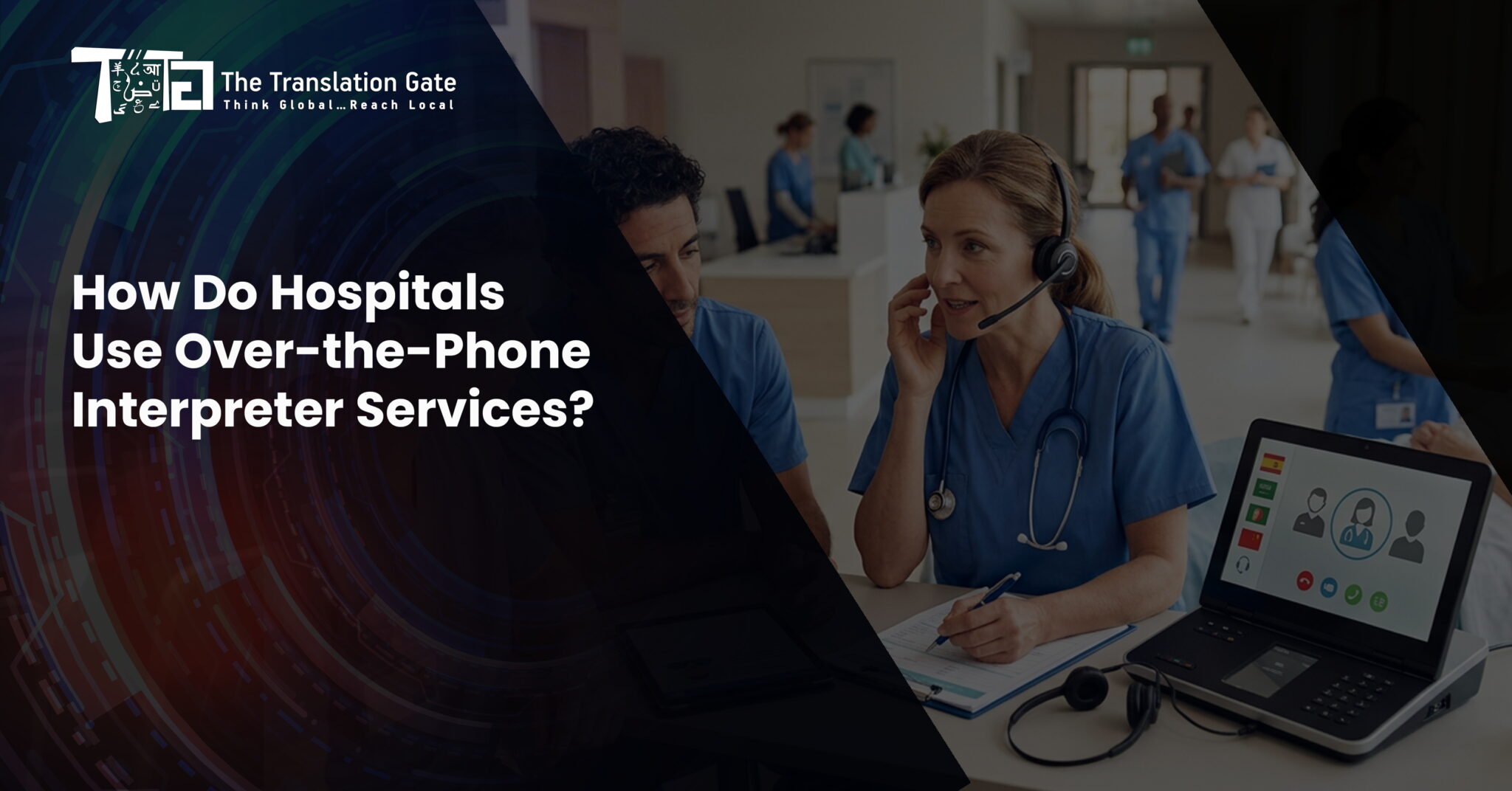
How Hospitals Use Over-the-Phone Interpreter Services
It’s 2 a.m. in a Level II emergency department, and a patient who speaks only Amharic is describing chest pain to a triage nurse who understands none of it. There’s no in-person interpreter on the overnight roster, and the next decision the care team makes depends on what the patient is trying to say.
This is the exact moment over-the-phone interpreter services exist for: a fast, reliable way to bring a qualified interpreter into the conversation without waiting for someone to physically arrive.
TL;DR
Hospitals use over-the-phone interpreter services when patients need immediate language assistance and an in-person interpreter is unavailable, impractical, or unnecessary.
OPI can support emergency care, triage, scheduling, and follow-up, but hospitals should still match the interpretation format to the clinical situation.
- OPI gives hospitals rapid access to a professional medical interpreter without scheduling delays.
- It’s especially useful for urgent, after-hours, and unpredictable language needs.
- OPI supports multiple hospital departments and patient touchpoints, from intake to discharge.
- It isn’t always the best modality; VRI or on-site interpreting may suit visual or complex encounters better.
- Hospitals should work only with qualified healthcare interpreters and a documented language access plan.
What Is Over-the-Phone Interpretation in Healthcare?
Over-the-phone interpretation (OPI) connects a hospital staff member and a patient with a professional interpreter over a telephone line. The interpreter isn’t in the room; they join by phone, listen to each party in turn, and relay the conversation, usually through consecutive interpretation, where the interpreter speaks after each short segment rather than simultaneously. It’s audio-only, real-time, and available in a matter of seconds through most providers.
In an OPI healthcare setting, that speed is the whole point. A nurse doesn’t need to know a patient’s language in advance or wait for a scheduled interpreter; they dial in, identify the language, and the conversation continues. The Translation Gate’s over-the-phone interpretation services work this way, and for many hospitals it’s the default first option before considering a consecutive interpretation session with an interpreter physically present.
When Do Hospitals Use Over-the-Phone Interpreter Services?
Emergency Departments and Urgent Care
Emergency department language needs are unpredictable by nature; a hospital can’t staff every language, every shift. OPI is commonly used during patient intake, gathering medical history, and nurse triage, when the priority is getting accurate information fast. It’s not a fit for every emergency scenario (a complex trauma case with multiple providers may call for on-site support), but for the initial exchange, telephone interpreter services often bridge the gap the fastest.
After-Hours and Overnight Care
Interpreter staffing tends to thin out overnight, even at hospitals with strong daytime language access. This is where 24/7 medical interpreter access matters most; OPI scales up or down with demand without requiring anyone to be physically on-site. The Translation Gate positions its healthcare OPI line as available around the clock for exactly this reason.
Follow-Up Calls and Patient Communication
Not every interaction is urgent. Appointment follow-ups, medication questions, and care coordination calls all benefit from on-demand interpreter services; a patient services team can connect a Limited English Proficiency (LEP) patient with a remote medical interpreter in minutes rather than rescheduling around interpreter availability.
Rural Hospitals and Facilities With Limited On-Site Coverage
Rural and smaller facilities rarely have interpreters on staff for every language their patients speak. Telephonic interpreter services supplement local coverage without hospitals needing to build an in-house team for languages that come up occasionally. This doesn’t mean replacing in-person support entirely. It means filling the gaps local staffing can’t reach.
How OPI Fits Into a Hospital Workflow
A workable OPI process for interpreter services for hospitals usually looks like this:
- Identify the patient’s preferred language
- Determine whether professional interpretation is needed
- Select the appropriate modality
- Connect with the interpreter
- Brief the interpreter on the clinical context
- Conduct the conversation
- Document the interaction per hospital policy
In practice: a patient arrives at the ED, staff identifies Spanish as the preferred language, a Spanish telephone interpreter is connected within moments, the nurse conducts intake, the physician explains treatment, and the interpreter relays the conversation accurately throughout.
What Can a Hospital Use a Phone Interpreter For?
Hospital Situation | OPI Suitability |
Emergency intake | High |
Nurse triage | High |
Appointment scheduling | High |
Follow-up calls | High |
Routine patient communication | High |
Complex physical examination | Consider VRI/on-site |
Sensitive multi-step consultation | Consider VRI/on-site |
Large multilingual meeting | Consider other modalities |
A study on medical interpreter challenges during in-person interpretation sessions, Medical Interpreter Challenges During In-Person Interpretation, found that even face-to-face sessions are far from friction-free: interpreters reported inconsistent training, cultural-competence gaps, and emotional exhaustion tied to the demands of in-person work. The insight for hospitals is worth sitting with: physically having an interpreter in the room doesn’t automatically mean a smoother or more accurate encounter. Modality is only one variable; interpreter training and support matter just as much, whether the session happens over the phone, on video, or in person.
OPI vs. VRI vs. On-Site Interpreting
Modality | Best For |
OPI | Immediate, audio-only communication |
VRI | Situations where visual cues matter |
On-site | Complex or high-touch clinical interactions |
VRI can carry facial expressions and body language that telephone interpretation can’t, clinically relevant in mental health assessments or when a patient’s non-verbal cues matter. On-site interpreting, including face-to-face interpreting, remains the strongest option for extended, sensitive consultations.
For larger clinical meetings or conferences involving multiple languages at once, hospitals sometimes turn to simultaneous interpretation instead, and in select settings, such as a companion quietly relaying information during a procedure, whispered interpretation has its place too. No modality is universally “better”; the right choice depends on urgency, complexity, and what the clinical moment actually requires.
How AI and Human Interpreters Work Together in OPI
AI has genuinely improved parts of the over-the-phone interpreter services experience: faster language identification, quicker interpreter matching, and call routing that used to take minutes now happens in seconds. Some providers also use AI to support interpreters in real time, surfacing medical terminology or flagging unclear audio before it becomes a misunderstanding. Used this way, AI is infrastructure behind the interpreter, not a replacement for them.
That distinction matters in a hospital setting. Machine translation still struggles with the things clinical conversations depend on most: nuance, tone, medical terminology used correctly in context, and the judgment to know when a patient’s words need clarification rather than a literal rendering. A qualified interpreter also carries cultural competence an algorithm doesn’t, recognizing when a patient’s hesitation signals confusion, discomfort, or something clinically relevant. In conversations tied to informed consent, discharge instructions, or diagnosis, an interpretation error isn’t a minor inconvenience; it’s a patient safety issue.
That’s why The Translation Gate pairs any AI-assisted efficiency with trained human interpreters on every call, rather than offering AI as a standalone substitute. AI can speed up how fast a hospital reaches a professional medical interpreter; it shouldn’t be the one interpreting.
What Should Hospitals Look for in a Professional Medical Interpreter Provider?
- Qualified interpreter credentials and healthcare-specific training
- Familiarity with medical terminology
- Strict confidentiality practices
- Broad language coverage, including less common languages
- Ability to handle urgent, unscheduled requests
- Consistent, monitored quality
- Experience specifically with hospital environments and multiple departments
Broader research on medical interpreting services as a field; medical Interpreting reinforces a point hospitals shouldn’t overlook: bilingual ability and professional interpreting competence are not the same skill. A staff member or family member who happens to speak both languages is not a substitute for a trained interpreter, particularly where informed consent or discharge instructions are involved. HHS guidance echoes this, emphasizing interpreter competence and accuracy as central to meaningful language access, and it’s worth linking back to The Translation Gate’s healthcare interpreter services and medical interpreter services for how that competence is vetted.
How Hospitals Can Get More Value From Telephone Interpreter Services
- Train staff on when and how to request an interpreter
- Record preferred language directly in the patient intake workflow
- Keep OPI access available wherever staff need it, not just at central stations
- Loop interpreters into relevant care-team communication
- Give interpreters clinical context before the call, not mid-conversation
- Avoid using family members as informal interpreters for anything clinically significant
- Track usage patterns to spot recurring language needs by department
AHRQ has pointed to staff training and better integration of interpreters into care teams as areas where hospitals still have room to improve, both of which cost little to fix and directly affect patient safety.
FAQ
- What is an over-the-phone interpreter service in healthcare?
It connects patients and providers with a professional interpreter by phone in real time, without requiring anyone to be physically present. - When should a hospital use a telephone interpreter?
Most often for urgent, after-hours, remote, or otherwise unpredictable language needs, where waiting for an on-site interpreter isn’t practical. - Is over-the-phone interpretation appropriate for medical conversations?
Often, yes, but the right modality depends on complexity. Routine intake and triage are well suited to OPI; highly complex or sensitive consultations may call for VRI or on-site support instead. - Is OPI better than video interpretation?
Not universally. OPI is faster for audio-only needs; VRI adds visual context that matters in certain clinical situations. - Are telephone medical interpreters available 24/7?
It depends on the provider. The Translation Gate offers 24/7 healthcare interpretation, including Spanish and dozens of other languages.
Conclusion
Over-the-phone interpreter services give hospitals a practical way to provide timely language access exactly when it’s needed, during an unpredictable ED case, an overnight shift, or a routine follow-up call that shouldn’t have to wait. Used alongside VRI and on-site interpreting rather than as a full replacement for either, OPI helps hospitals meet patients in whatever language, and whatever moment, communication happens to occur.
Need reliable over-the-phone interpretation for your hospital or healthcare organization? Contact The Translation Gate to discuss your language access needs.