
MTPE or PEMT is a translation method that combines two of the most important factors that can elevate and enhance the quality of any translation, which are machine translation, a cutting-edge technology dominating the translation world in recent years, and human translation, which adds cultural nuance, accuracy, and creativity to any translation.
With the current rise in AI translation, the demand for editors who are skilled and talented has consequently risen to fix and enhance the quality of said translation. It is an affordable, efficient, and productive solution for people who are seeking fast yet accurate translation for high-volume projects.
In this article, we will explore the meaning of MTPE service and the technical process, as well as the reasons behind the increased demand for this service.
What Does MTPE Stand for and What Does It Mean?
MTPE, which stands for Post Editing of Machine Translation, is the process where a skilled translator revises and edits MT or machine translation. It is considered a bridge between rapid AI translation and skilled and nuanced human translation.
Machine translation on its own often has errors, cultural misunderstandings, and produces literal translation, and under the supervision of a professional translator, all these issues would be avoided.
MTPE Process: Step-by-Step Guide
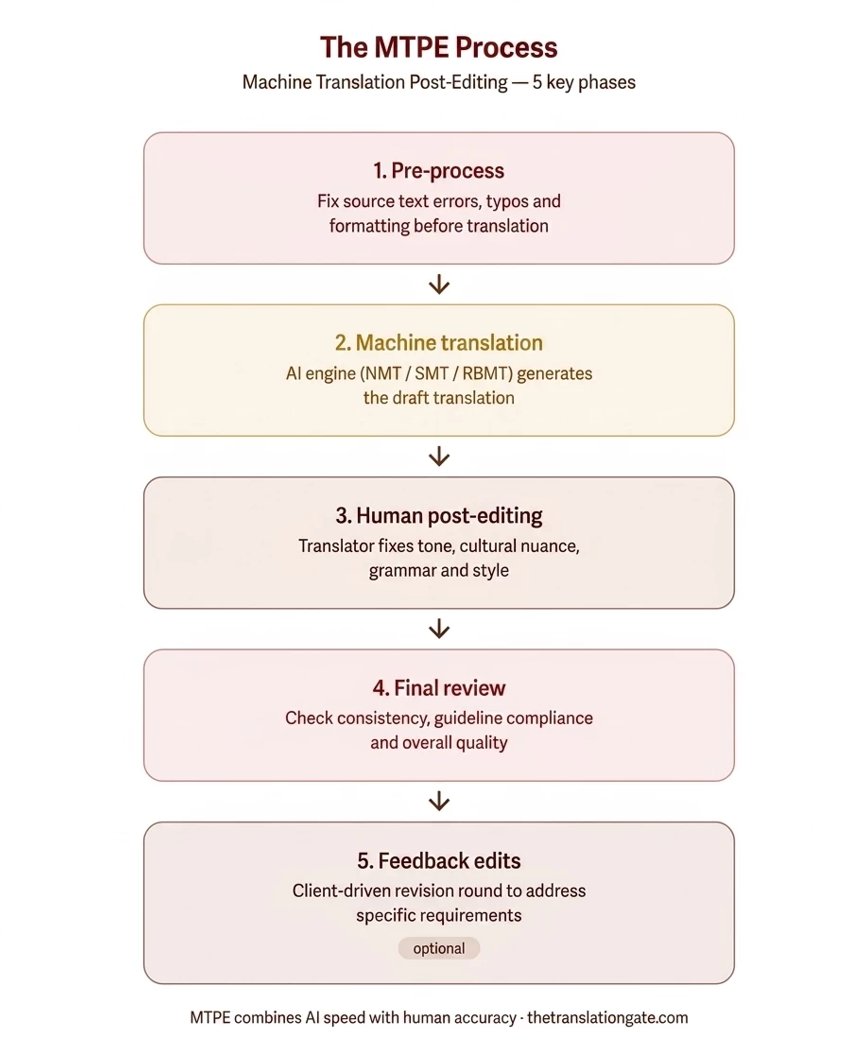
When it comes to the post-editing of machine translation, the process consists of four main phases.
- Pre-Process or Preparation of Text
This phase is done to prepare the text for machine translation by fixing any grammatical errors or typos in the source content. It is done to minimize translation errors and ensure better outcomes from the machine translation software.
- Machine Translation (MT)
This is the second step of the process, one of the translation engines or (AI translation software) would create a translation of the source content to the target language.
- Human Post-Editing
After receiving the translated text, a translator would work on the draft to fix any cultural misunderstandings, literal translations, grammar, style, or meaning.
There are different types of post-editing of machine translation, and we will explore them more next.
- Final Review
This is often needed to check if the text is adhering to the guidelines, if there is any inconsistency that needs fixing, or if there is any issue regarding the quality of the translation.
- Feedback Edits (optional)
This phase is not always available; however, it is implemented after receiving feedback from the client. Another round of edits would be implemented to edit/fix the target text in accordance with the client’s needs.
It is often hard to find an MTPE specialist who is an expert in this process, but we have a whole team to help your company.
Check the full details about MTPE now! (Button)
What Are the Types of Post-Editing Machine Translation?
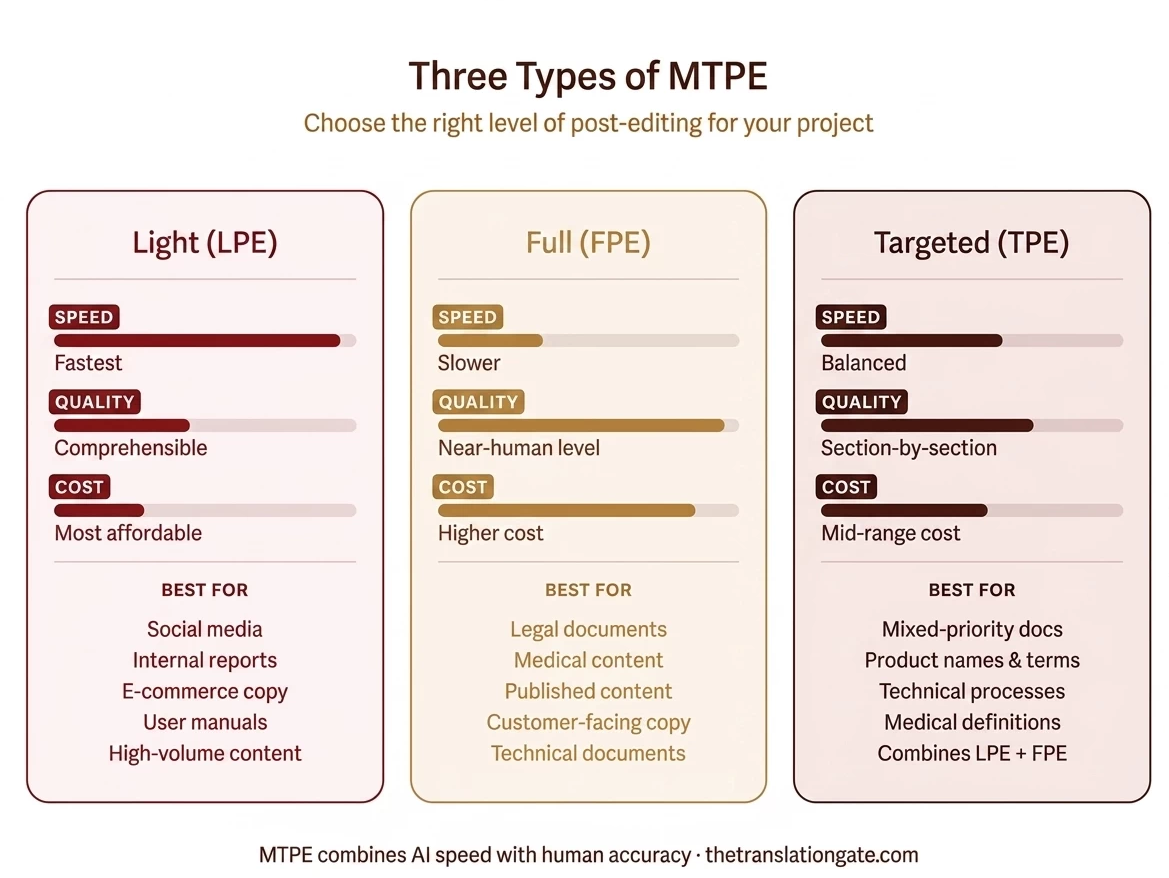
MTPE has three different types: light post editing translation, full post editing, and targeted post editing.
- Light Post-Editing (LPE)
Light- post editing prioritises speed and efficiency over impeccable accuracy. It focuses on correcting the most critical mistakes and mistranslations, ensuring that texts are comprehensible and understandable.
Usually, it focuses on fixing the major issues like typos, omissions, and grammar. There is no syntax polishing or stylistic edits.
Light Post-Editing (LPE) Uses:
- Large volume and low-budget content
- Internal communication and reports
- User Manuals & Technical Documentation
- Social media posts
- E-commerce product descriptions
- Full Post-Editing (FPE)
Full post-editing edits the text on a deeper and more thorough level. It aims to humanize the text so that it can even be indistinguishable from professional translators. It focuses on style and adjusts it in relation to the target audience, consistency in terminology and tone, and accuracy, as it fixes all errors and grammatical issues.
Full Post Editing Uses:
- Legal documents
- Customer-facing content
- Published Content
- Technical Documents
- Medical and pharmaceutical content
- Educational Content
- Targeted Post-Editing(TPE)
This type is often used when there are specific sections in the content that are more important than the rest. It combines both light post editing (LPE) and Full post editing (FPE), depending on the importance of the section. It is the perfect balance between speed and quality. It focuses on correcting specific parts like product names, technical processes, or medical definitions based on the client’s priorities.
Light Post-Editing (LPE) Vs Full Post-Editing (FPE):
| Light Post-Editing (LPE) | Full Post-Editing (FPE) | |
| Accuracy level | Understandable | Near Human Level |
| Consistency | If it doesn’t affect the meaning, it is ignored | Focus on Consistent tone and style |
| Speed | Faster | Slower |
| Budget | Cheaper than FPE | More Expensive than LPE |
| Reduced Risk | – | Minimizes the risk of mistranslations |
| Purpose | Improve readability for high-volume, low-stakes content. | Quality, consistency, and compliance |
As a business, using a good balance of both services can save you time, money, and improve the quality of your translation. This service will be the door to reach your global customer base.
Go international today with our services.
See How Much You Can Save with MTPE
Why Is the Demand Increasing for MTPE?
There are numerous reasons why people are choosing post-editing of machine translation. A study posted by Nimdzi in 2024 has shown a huge increase in demand for MTPE, with 75% growth in less than 3 years. Reasons for this surge are cost efficiency, productivity, improved quality, and Global trade.
- Cost Efficiency
The main reason MTPE is popular now is that this service is more cost-effective than pure human translators. It has even cut the cost of human translation by 40%. With the global inflation crisis, companies are searching for ways to cut costs.
- Improved Quality
Reduced cost is not the only benefit that comes out of MTPE, but quality as well. In comparison with Raw MT translation and even Human translation, several studies have found that MTPE produces fewer mistakes. Raw Machine Translation produces a lot of inaccurate and mistranslations, and human translation is time-consuming and has lost the edge against Post-editing of machine translation.
- Increased Productivity
As well as the increased productivity, according to a study conducted in 2023, a linguist has discovered that MTPE is faster than human translation, with around38% in 8 out of 11 language pairs. Another study has said that the productivity level has increased 74%.
- Global Trade Activities
The global trade market that has flourished recently has increased demand for business and financial documents translation to bridge the gap between cultures, and MTPE might be the perfect solution for that.
If your business is not global yet, you will be missing all the international opportunities to reach your clients/customers. MTPE will bring your world closer by bridging the gap without costing an arm and a leg.
Why Choose The Translation Gate MTPE Service?
The translation gate’s Machine Translation Post-Editing( MTPE) Service offers unique benefits with more than a decade in the translation business. They offer the following:
- Hybrid Efficiency
Basically, you will enjoy the best of both worlds, machine translation, quick and cost reduction, with the experience and complexities of human translation.
- Lightning-Fast Turnaround Times
With a team of expert post-editors, our team is capable of producing high-quality MTPE content faster than you would expect.
- Consistency
You won’t have to compromise or lose the real brand voice and tone. Our post-editors are more than capable. They will maintain tone, rhythm, and personality.
- Industry-Specific Expertise
The Translation Gate offers tailor-made and expert MTPE in 10+ industries. Our team has experience in handling a wide range of industrial sectors.
- Scalable Solutions for Any Project Size
We provide a wide range of services, tailor-made to your company’s needs. Whether product catalogues, global campaigns, or large websites, manuals.
Our team has years of experience handling all types of projects.
Get a Free MTPE Sample Translation
Best Practices for Effective Post-Editing
When it comes to MTPE, there are a lot of practices that could influence the quality of the translation, and here are the best practices for effective MTPE.
- Understand Your Machine
There are several methods and models for machine translation, like NMT, RBMT, and SMT, etc. A good post editor must understand how each model works so that they can work with it and produce the best outcome.
- Define Clear Quality Guidelines
Before starting, a professional editor would establish the guidelines that they would work with. Instructions regarding terminology, style, tone, and formatting.
- Understand the Culture of the text.
The best part of a human translation is the deep understanding of the cultural context of the text and their ability to translate in accordance with it. A post- editor is expected to have the cultural knowledge and add this as a dimension to their edits.
- Integrate Tools
There are a lot of Computer-Assisted translation (CAT) tools that can make this process even faster. Combining MT, editing software, and post-editing interfaces will help greatly.
- Use Feedback Loops
Constantly reviewing and fixing repeated errors would refine the text and pick up inconsistencies. After the feedback, update your translation memory, glossaries, and other machine learning/AI models that rely on feedback.
- Track Your Metrics
Track your time, the machine errors, and cost in order to refine and develop a more efficient workflow.
Conclusion
In short, MTPE or PETM is one of the best hybrid solutions for translation so far. It picks the best of the human mind and the efficiency and capabilities of the machine to reach new levels and produce high-quality content. With a specialised MTPE team at your beck and call. Your business will thrive worldwide, keeping the costs at bay while still translating all your products info or services to as many people as you can. The translation gate is your bridge to globalise your business.
Frequently Asked Questions (FAQ)
What Is Post-Editing of Machine Translation (MTPE)?
Post-editing of machine translation (MTPE) is the process of refining machine-generated translations using human expertise. A professional linguist reviews and edits the output to improve accuracy, fluency, and cultural relevance, combining the speed of AI with human quality.
Is MTPE Better Than Human Translation Services?
MTPE is not a replacement for human translation but a complementary solution. It is ideal for high-volume, fast-turnaround content where cost and speed are priorities, while human translation remains the best for creative, legal, or highly sensitive content.
What are the MTPE Rates?
MTPE pricing depends on several factors, including word count, language pair, content complexity, and the level of editing required (light or full). However, it is typically 30–50% more cost-effective than traditional human translation. You can request a custom MTPE quote based on your project needs.
Is MTPE the same as PEMT?
Yes, they are both interchangeable terms for Post-editing of Machine Translation in the localization industry.