
The recent Industrial and manufacturing boom that started in 2024 in the USA is due to new factories opening for electric vehicles, memory chips, and drugs, resulting in factories and industrial projects needing interpretation services, whether OPI, VRI, or on-site services.
Interpretation services for factory floors, technical manuals, and industrial teams are essential for the communication and progress of any project with many workers who are entering the USA as part of big projects or immigrant workers residing in the USA; their number is close to 20% of the US workforce, which is about 30.8 million foreign workers.
This article will explore the types of interpretation & translation services for factories and industrial areas, what you might need a manufacturing interpretation service for, and how to pick them.
Types of Interpretation Services for Industrial Environments
When it comes to language services that your factory might need, they would probably be either translation or interpretation. Here are the most used interpretation services in the industrial and manufacturing fields:
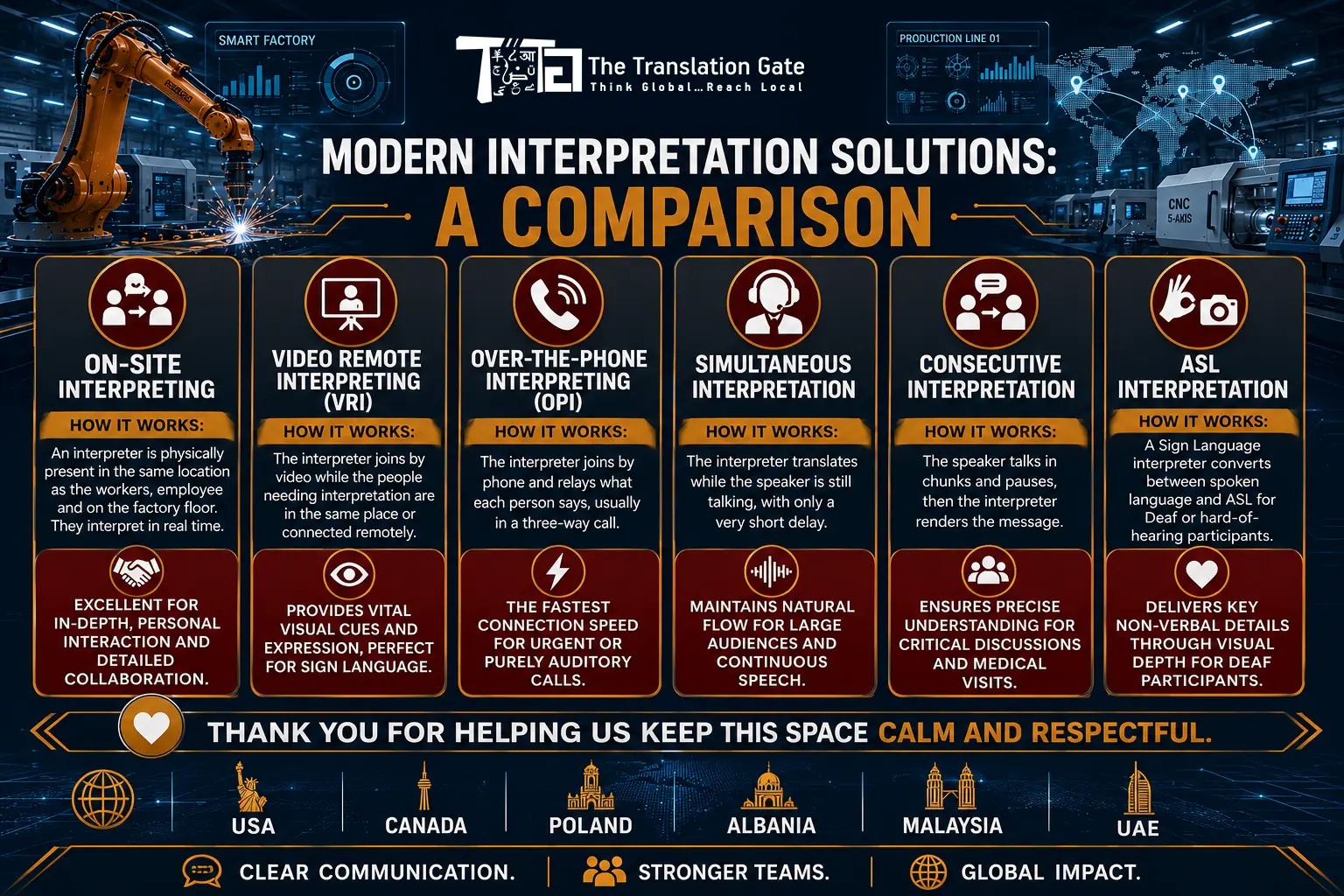
- On-site Interpreting
How it works: An interpreter is physically present in the same location as the workers and employees on the factory floor. They interpret in real time. This is the most direct setup and is often used in meetings.
It is more expensive because of travel and scheduling; harder to arrange on short notice; limited by interpreter availability and location.
However, The Translation Gate offers interpreters at affordable prices. TTG branches around the world, in the USA, Canada, Malaysia, Albania, Poland, and the UAE, mean that not all our interpreters would require accommodation or travel expenses, saving you thousands.
- Video Remote Interpreting (VRI)
How it works: The interpreter joins by video while the people needing interpretation are in the same place or connected remotely. It is especially useful for sign language and any situation where visual cues matter.
Request a Video Remote Interpreting (VRI) free consultation.
- ASL Interpretation
How it works: A Sign Language interpreter converts between spoken language and ASL for Deaf or hard-of-hearing participants. This can happen on-site, via video, or, in some cases, through specialized remote services.
Book an ASL interpretation service today.
- Over-the-phone Interpreting (OPI)
How it works: The interpreter joins by phone and relays what each person says, usually in a three-way call. This is commonly used when speed matters and no video is needed. It is useful for brief, straightforward conversations and can be cost-effective.
If you need more information, check our article on How to Choose an Over-the-Phone Interpretation Company
Schedule an OPI instantly.
- Simultaneous Interpretation
How it works: The interpreter translates while the speaker is still talking, with only a very short delay. It is common in conferences, live events, and court-style settings with specialized equipment or booths.
Schedule a Simultaneous Interpretation Expert Now.
- Consecutive Interpretation
How it works: The speaker talks in chunks and pauses, then the interpreter renders the message into the other language. It is common in interviews, medical visits, legal meetings, and smaller discussions.
Reserve our Consecutive Interpretation Professional Service Today
The Translation Gate offers tailor-made interpretation & translation solutions
The Difference Between Consecutive vs. Simultaneous Interpretation for Noisy Environments
When it comes to choosing your interpretation service, whether between consecutive and simultaneous interpretation, there is no clear answer; each type has a list of pros and cons, and only by understanding your needs can you determine which is best.
Some would say consecutive interpretation is usually the safer choice when accuracy and speaker control matter, while simultaneous interpretation is better when the event must keep moving in real time. However, we would let you be the judge after reading the following comparison.
- Consecutive Interpretation
Pros: Usually more accurate for detailed exchanges; does not require special booth equipment; allows the interpreter to fully hear and process each segment.
Cons: Takes longer because the speaker must pause often; can interrupt the natural flow of conversation; may be impractical for large events or time-sensitive sessions
- Simultaneous Interpretation
Pros: Keeps events moving without long pauses; works well for large audiences and live presentations; efficient for formal multilingual settings.
Cons: Extremely demanding for interpreters; higher risk of fatigue or small
errors; it often requires equipment and more planning, which increases cost.
Choose the right service to ensure accuracy, professionalism, and a continuous, consistent workflow for multilingual interpretations in your factory.
How to Choose the Best Interpretation Service for Your Needs?
In my opinion, on-site for hands-on or high-stakes work, phone for quick calls, video for remote conversations with visual cues, and simultaneous for live events.
However, there are many factors to consider when choosing the best interpretation service for your company, such as:
- The Subject Matter
- The Language Availability
- Industry Expertise
- Latest Technology
- Confidentiality
- Scalability
- Clear Pricing
- Reliable Scheduling
Why Using AI Interpretation Can Easily Cost You Millions?
AI interpretation can become expensive when a mistake changes the meaning in legal, medical, safety, or contractual communication. It can cost you your whole business; even a wrong term, missed nuance, or failure to understand context can lead to delays, compliance issues, liability, and major business losses. These are reasons why AI will probably be unable to replace human interpreters, but will become a tool for faster and more efficient work.
Additionally, AI struggles more in noisy environments, fast speech, multiple speakers, accents, and emotionally sensitive conversations, which makes it risky for complex use cases. For that reason, the National Council on Interpreting in Health Care recommends human interpreters for critical communication and AI only for lower-risk, straightforward situations.
Conclusion
Factory Interpretation and Technical Interpretation are now more important than ever, with the rapid industrial development in the USA. It is important to choose the right Interpretation services for factory floors, technical manuals, and industrial teams. Maintain your workers’ safety and efficiency by providing your industrial team with reliable and professional interpretation services, such as on-site, VRI, OPI, and ASL interpretation, according to your factory’s needs. Don’t risk your time and money by choosing inadequate AI options that would struggle with complex terminology, accents, and loud, noisy environments.
At The Translation Gate, we offer all that and more. With access to more than 260 languages, we make it easy to find the right support for your needs. We also provide trained professionals across more than 30 industries, including Manufacturing and technical interpretation. Backed by over a decade of experience, we can help you get the service your company needs.
Schedule a Multilingual interpretation Call today.
FAQ
What Types of Manufacturing Documents Does The Translation Gate Translate?
The Translation Gate handles the full range of manufacturing content, including user manuals, SOPs, work instructions, safety data sheets, technical specifications, quality documents, and training materials. It also covers labels, packaging, regulatory files, and other production-critical documents.
How Do You Ensure Accuracy in Technical and Engineering Translations?
Accuracy comes from using industry-specific translators, approved glossaries, translation memory, and a structured review process. For technical content, every term, measurement, warning, and layout detail must be checked for consistency, compliance, and usability.
At The Translation Gate, we offer professional certified technical translators who can accurately handle any tech or engineering documents, manuals, etc
Can The Translation Gate Support Global Manufacturing Operations?
Yes, The Translation Gate can support global manufacturing by helping teams standardize multilingual documentation across factories, suppliers, and regional markets. That kind of support improves speed, compliance, and communication across international operations.
What Interpretation Services Support Factory Floor Communication?
Factory floor communication is usually supported by on-site, video remote, or phone interpreting, depending on the setting and urgency. These services help supervisors, line workers, safety teams, and inspectors communicate clearly during training, shift handovers, audits, and emergencies